
RAMSES and the Close Approach of Asteroid Apophis

On April 13, 2029, asteroid Apophis, which is approximately 340 meters in diameter, is expected to pass within about 32,000 kilometers of Earth. This distance is closer than geostationary orbit, making the encounter exeptionally rare in the history of asteroid observations. RAMSES, the Rapid Apophis Mission for Space Safety, is a joint mission of the European Space Agency (ESA) and JAXA designed to take advantage of this opportunity and investigate in detail how Earth’s gravity affects the asteroid. The mission is also highly significant for planetary defense because it will improve our understanding of asteroids that could pose an impact threat to Earth. JAXA is participating in this international mission by contributing key spacecraft technologies and scientific instrumentation.
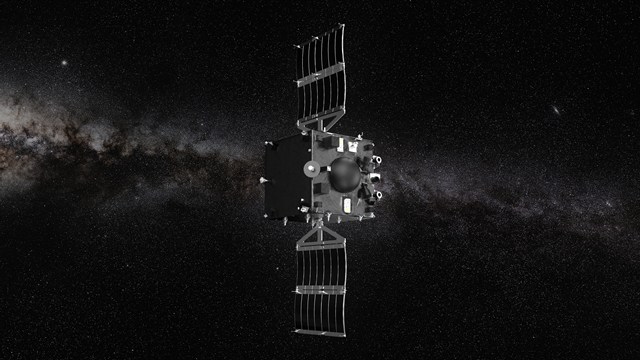
Key RAMSES Specifications
| Item | Details |
|---|---|
| Spacecraft Dimensions | Approx. 1.6 × 1.6 × 1.6 meters |
| Mass | Approx. 1.3 metric tons (including propellant) |
RAMSES Observation Plan
| Item | Planned Details |
|---|---|
| Launch | FY2028 |
| Arrival at Apophis | February 2029 |
| Before Closest Approach |
March 1 to April 11, 2029 20 to 1 km from Apophis |
| During Closest Approach |
April 12 to 14, 2029 5 km from Apophis |
| After Closest Approach | Operations continue from April 15, 2029 |
| Extended Operations | Autonomous guidance and control experiments, evaluation of control performance, and commercial deep-space testbed activities |
Objectives of RAMSES
RAMSES will continuously observe Apophis with high precision before, during, and after its closest approach to Earth. As the asteroid nears Earth, gravitational tidal forces may change its orbit and rotation and may cause landslides or small deformations on its surface. Using high-resolution cameras, a laser altimeter, radar for probing the interior, and other instruments, RAMSES will monitor these changes with a temporal resolution of several minutes. The resulting data should improve understanding of the asteroid’s structure and strength and help determine which mitigation measures would be effective if an object posing an impact threat is discovered in the future.
Main Instruments on the RAMSES Spacecraft
| Instrument | Primary Role and Observations |
|---|---|
| Visible-Light Camera | Acquires detailed images for characterizing the shape and surface features of asteroid Apophis. ESA is primarily responsible for the visible-light camera, while JAXA will provide the thermal infrared imager used to study surface temperature distribution and material properties. |
| Thermal Infrared Imager (TIRI) | Measures surface temperature distributions and investigates the thermophysical properties of near-surface materials. Multi-band spectroscopy will be used to study the types and characteristics of surface materials. JAXA will provide this thermal infrared imager. |
| Laser Altimeter | Precisely measures the distance to the asteroid, supporting collision-avoidance operations near the object and supporting spacecraft navigation and contributing to measurements of the asteroid’s gravitational field. |
| Radar | Investigates the internal structure of Apophis, including whether it contains voids. |
| Gravimeter | Measures the asteroid’s gravitational strength from minute changes in spacecraft motion and estimates its mass and internal mass distribution. |
| Radio Science | Precisely analyzes radio communications between ground stations and the spacecraft to estimate the asteroid’s mass and gravitational field and determine the spacecraft’s orbit with high accuracy. |
| Two Deployable Small Spacecraft (Including CubeSats) | Separate from the main spacecraft to approach the asteroid and conduct supplementary observations of its near-surface environment and internal structure. Planned activities include observing dust released from the surface. One spacecraft will also attempt to land on Apophis and measure seismic activity. |
JAXA’s Role
JAXA plans three principal technical contributions to RAMSES. The first is the Thermal Infrared Imager (TIRI), an instrument based on technologies developed for Hayabusa2 and ESA’s Hera mission that can help infer material properties and internal structure by measuring surface temperature distribution. The second is a set of thin, lightweight, high-performance Solar Array Wings (SAWs), which will provide sufficient power within strict mass constraints and improve overall spacecraft performance. The third is a launch opportunity on an H3 launch vehicle through a rideshare with DESTINY+. This cooperation, ranging from scientific instrumentation to launch services, will represent the first full-scale collaboration between ESA and JAXA in planetary defense.
 ©ESA
©ESA
Significance for the Future
RAMSES is more than a scientific mission to study an asteroid in detail. It will also help improve scientific understanding of asteroid hazards and strengthen preparedness for a potential impact event. Applying JAXA’s strengths in observation and space transportation to an international mission is also expected to create new benefits for research and industry in Japan. The mission may also increase public awareness of how space science and technology contribute to the long-term safety of society. RAMSES will demonstrate how international cooperation can advance planetary defense and improve preparedness for asteroid hazards.