
Hera and JAXA’s Contribution to Planetary Defense
Led by the European Space Agency (ESA), the Hera mission is a major exploration project designed to advance the validation of asteroid-deflection techniques for planetary defense. It follows NASA’s Double Asteroid Redirection Test (DART), which was conducted in 2022. The DART spacecraft deliberately collided with Dimorphos, the small moon of the binary asteroid Didymos, altering its orbital period. Hera will survey the Didymos-Dimorphos system several years after the DART impact and examine its effects in detail. By comprehensively studying Dimorphos’s shape, the impact crater, material distribution, and the extent of the orbital change, Hera will help quantify the effectiveness of the kinetic impactor technique as a method of asteroid deflection. Together, the DART experiment and Hera’s follow-up investigation will provide data needed to improve models and technologies for future asteroid-deflection missions.
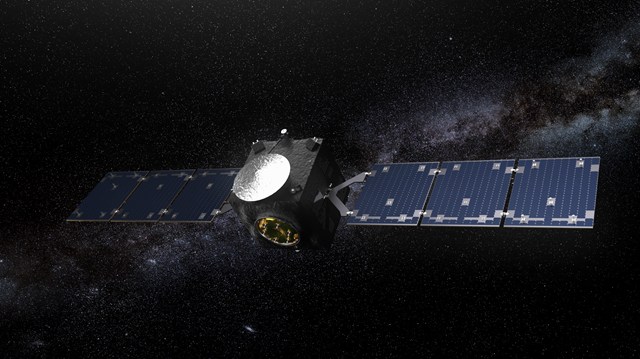
Key Hera Specifications
| Item | Details |
|---|---|
| Spacecraft Dimensions | Approx. 1.6 × 1.6 × 1.6 meters (11.5 m across when deployed) |
| Power Generation | Maximum: 1,180 W |
| Mass | 1,150 kg (with propellant), 667 kg (without propellant) |
| Launch | October 7, 2024 (Falcon 9) |
Hera’s Instruments and Japan’s Contribution
Hera carries several scientific instruments, including the Thermal Infrared Imager (TIRI) provided by Japan. A thermal infrared camera detects infrared radiation emitted from an object and maps its surface temperature distribution. By measuring surface temperatures in detail, TIRI will help characterize the thermophysical properties of materials at and near the asteroid’s surface. Fine, sand-like material, for example, heats and cools more rapidly than consolidated rocky material. Observing these differences makes it possible to infer variations in surface structure and composition. TIRI builds on the thermal infrared camera technology flown aboard Hayabusa2, which conducted pioneering thermal-infrared imaging of an asteroid and returned valuable data. This experience is being applied to Hera, allowing JAXA to make a significant technical contribution to the mission’s scientific observations.
Main Instruments on Hera
| Instrument | Primary Role and Observations |
|---|---|
| Visible-Light Camera (AFC) | A monochrome visible-light camera for observing Dimorphos’s shape and surface topography. It is also used for navigation, guidance, and control during the approach. |
| Laser Altimeter (PALT) | Provides precise range measurements that support gravitational-field characterization and safe navigation during close-proximity operations. |
| Thermal Infrared Imager (TIRI) | Measures surface temperatures to characterize the thermophysical properties of near-surface materials. Multi-band infrared observations help constrain the composition of surface materials. |
| Hyperspectral Imager (HyperScout-H) | Measures reflected spectra from the asteroid’s surface to investigate mineral composition and space weathering. |
| Radio Science (X-DST, ISL) | Uses range and Doppler measurements from Earth to determine the spacecraft’s position and characterize the gravitational fields of Didymos and Dimorphos. Ranging between the main spacecraft and CubeSats enables further investigation of the gravitational fields of both asteroids by analyzing the CubeSats’ trajectories. |
| CubeSat 1 (Juventas) | Uses the JuRa low-frequency radar to investigate the asteroid’s internal structure and the GRASS gravimeter to measure the local gravitational field. |
| CubeSat 2 (Milani) | Uses the ASPECT visible and near-infrared imaging spectrometer to study surface mineral composition in detail and the VISTA dust monitor to measure surrounding dust. |
Application to the RAMSES Mission
Knowledge gained from Hera is expected to support the development of future missions. One example is RAMSES, a joint JAXA-ESA mission to asteroid Apophis that uses a spacecraft design derived from the Hera platform. Apophis is expected to pass extremely close to Earth in 2029, providing a rare opportunity to observe how a close encounter with Earth affects a small asteroid. Because the preparation period for RAMSES is very limited, reusing technologies and development and operational processes established for Hera will help meet RAMSES’s compressed development schedule. The progression from Hera to RAMSES illustrates the value of sustained international cooperation and the cumulative development of planetary defense technologies and expertise.